18. The Rule of Law
While it is hard to decide if moral values are subjective or objective, laws are supposed to be objective and followed by all the people, unless the law itself calls out some exemptions. It is universal to society. Who set these rules? In an authoritarian country or a monarchy, the ruler sets the rules. In a democracy, voters have an indirect say - they elect the people who make most laws, though constitutions put some laws beyond the reach of a simple majority. A simple majority is usually not enough to change the laws in the constitution itself.
What types of political philosophy are out there? People use many labels - socialist, conservative, libertarian, anarchist, fascist, centrist, and so on. They don’t all sit on one neat line; they describe different things (how the economy should run, how much the state should control, how fast things should change), which is why the labels blur into each other like colours. To make matters worse, most normal people tend to accept different ideas from different political philosophies. I won’t dig deep into each philosophy. I will just discuss general problems and ideas with political philosophy.
What Are You Free to Do?
Most political philosophies come down to a question of what you should be free to do and what you should not be. A free-market libertarian may say that individuals and businesses must be free to indulge in any economic activity while a socialist might say that there must be limits to what they can do for the sake of economic activity. A social liberal may say that people from outside the country should be free to get into the country while a conservative says that there are limits to it.
Ultimately, in a democracy, people decide how much freedom they are willing to give up in return for things like social and economic safety. If you want to completely reduce crime, you may have to let the government do some level of surveillance. If you want guaranteed free healthcare from the government, you need to be ready to deal with the baggage that comes along with it in terms of taxes, rules the government passes to promote a healthy society so that the cost of healthcare can be reduced, etc.
The thing about absolute freedom is that it cannot exist without an entity that guarantees you that. And that entity protects your freedom by taking away the freedom of people who try to take other people’s freedom. This puzzle - freedom needs a protector, and the protector limits freedom - is a well-known objection to anarchist ideas. It’s related to what the philosopher Karl Popper called the paradox of tolerance. Both these political philosophies still need people to follow certain rules. In an anarcho-communist society, you need people to not hog resources and in an anarcho-capitalist society, you need people to respect property rights. How to ensure this happens? Any pseudo-enforcer you create eventually becomes a power structure and hence a government. The anarcho-communist and anarcho-capitalist may argue that people themselves are the enforcers. Unless one can genetically modify the population to ensure that they will follow these rules automatically, I don’t see how this can happen.
In a democracy, are people free to choose or vote for a model that is not a democracy? It is for this reason, countries have a constitution that makes it hard to do so.
In an authoritarian country, people don’t generally get to choose what one is free to do. It is based on the whim of their leader. You dance if they want you to dance.
Nuances
Politics also suffer from the same problem of nuance that morals suffer from. Laws are written using words of language and we already saw how approximate and inaccurate language can be. Are the laws strong enough to cover all the situations? There is a reason why many legal documents are the size of War and Peace. But no matter how hard they try, it doesn’t capture all the nuances.
How should laws handle this? Some tend to have a clause that says which side to err in case of doubt. For example, American courts have developed a guideline for free-speech cases: when it’s a close call, they lean toward protecting the speaker. That comes from court decisions over the years, not from the actual words of the First Amendment.
In some other laws, it is usually left to the courts and police to decide which way to lean. This usually results in lots of inconsistencies in decisions made, depending on the bias of the judges and the police.
Political Debates
Modern day politics is quite exhilarating. You see debates raging across pretty much every social media. It is almost impossible to avoid it, no matter how hard you try. Sometimes, all I want to watch is dog videos and the social media decides to recommend the most polarising political posts to me.
What really is the goal of these debates? We saw in the previous chapter that we don’t share common moral values with everyone. Depending on the situation, this is what political debates boil down to:
- Their fundamental beliefs are different. If this is the case, then there is no point in arguing about laws and political parties. If one person believes that safety and security is more important than freedom and the other person believes the opposite, is there any point in them debating?
- The moral goals may align a bit but they still argue over how they achieve these goals. They argue about which method is better.
- They may just criticise the inconsistencies in each other’s moral framework. As we saw in the previous chapter, there are nuances in every person’s moral framework that are many times contradictory.
And this is why I hate many debates:
-
Objectivity vs Subjectivity - People tend to disagree on what is objective and subjective. As we saw in the earlier chapters, it is a hard philosophical problem. It is fun in a philosophical debate but not so much in a political debate.
-
Knowledge gap - As we saw in the chapters about science, we have lots of gaps in the understanding of the world. People fill the knowledge gaps in different ways. Take any popular criminal case. You see people taking sides with very little information they have. Is that wrong? Not at all. But I am surprised how confident people can be when they are debating these cases. Even the lawyers in the real court cases aren’t generally this confident.
-
People fighting over language inaccuracies, nuances and generalisations. Many people jump into debates using words like socialism and communism without a shared understanding of what they mean - so all you get is people talking past each other. Both the left and right are notorious for making this mistake.
- For example, some people treat communism as equivalent to Marxism. But communism, as an end-state, is just a society with no private ownership where property is owned by all - and Marxist communism is only one route to it. Even Christian communes count as communist on this definition.
- Some people see socialism as state ownership of means of production. Sometimes, people treat social democracy where higher taxes are used to give services to people as socialism. Again, not entirely wrong. But people need to agree on definitions before jumping into arguments.
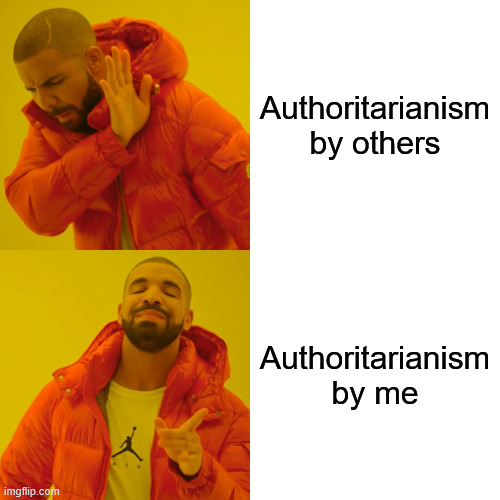
I hope you’re as frustrated with modern political discourse as I am. For most people, this seems to be their ideology:
Further Reading
- The Righteous Mind by Jonathan Haidt
- Does the Center Hold? By Donald Palmer The Worldly Philosophers: The Lives, Times, and Ideas of the Great Economic Thinkers by Robert L Heilbroner