17. What Ought To?
Is it okay to tell a lie to a dying person so that they can die happily? Some would say that telling lies is wrong irrespective of the situation. According to them, good and bad are features of the action, irrespective of the outcome. Others would say that we should lie if the person can at least die happily. These people claim that good and bad depend on the outcome, not on the act itself.
Welcome to the world of moral values. Remember, how we humans love to build systems with statements which are consistent with each other and the rules of logical reasoning are followed? Most of our moral values are the opposite of that. The nuances are insanely difficult to document.
Killing is wrong, but it is okay to do in self defense or to euthanise a suffering person. Swearing is wrong, but it is okay to do so in a stand-up comedy where all the audience are informed that a lot of swearing is going to happen. It is good to be open and honest, not if you are talking to a person who can’t handle honest feedback well and is your manager at work. I can go on and on.
It would be a crime to discuss moral philosophy without discussing the Trolley problem - a thought experiment invented by philosopher Philippa Foot in 1967 and made famous by Judith Jarvis Thomson in the 1970s.
A runaway trolley is speeding down a track toward five workers who cannot move. You stand next to a lever that can divert the trolley onto a side track where one person is standing. If you pull the lever, the trolley kills one person on the side track instead of the five on the main track. Do you pull the lever and actively cause one death, or do nothing and let the five die?
There are several variants to this. What if the one person is your friend while the five are strangers? What if the five people are criminals while the one person hasn’t committed any crime? What if the five are old people and the one is a young child?
There is also a twisted scenario where there is only one track with five people. Instead of using a lever, you have to push a person next to you onto the track to stop the trolley. If your answer to the original trolley problem was that you will pull the lever, will you also choose to push the person next to you? Instead of being clever trying to find some loophole in the situation itself, look at it from a moral angle. What is the right thing to do?
Moral dilemmas generally happen when we run into conflicts between one person’s desires and another person’s desires. One person may want a calm commute to work. Someone else may think it is cool to play loud music. Who is morally right here? I am pretty sure that the person who wants a calm commute is morally correct and the person blasting music on speakerphone is in the wrong - though prison might be a slight overreaction. But that person may disagree. We come across such conflicts in our personal lives, workplaces, commute and travel all the time. Why is this so hard?
What Is?
As we have discussed in numerous chapters above, we haven’t really understood the nature of reality. We get around it by setting some brute laws. But different people may still have their own belief system about reality. So we don’t have a foundation to start with. If someone says animals don’t have consciousness and can be killed but another says they do have consciousness, how do we resolve this conflict without knowing if animals have consciousness or not?
If you have zeroed in on a philosophy like physicalism or dualism or idealism, you could potentially build morals out of it. But as most existing philosophies tend to struggle with answering questions like what is life and what is not. So if you want to build your morals based on your existing philosophy, you may want to add details about the definition of life in your philosophical system.
Subjectivity
As discussed earlier, there are certain features of the world which are subjective. Many philosophers consider morality to be in this category. In modern day Western countries, the widely but vaguely accepted moral is that you can do whatever you want as long as it doesn’t affect others. It is based on Stuart Mill’s harm principle. This automatically rules out killing or hurting others. This belief also has grey areas. Is it okay for your neighbour to play loud music in the daytime? Many would agree that it is wrong to do so in the night but daytime is okay. What if you work night shifts and sleep during the day? How about emotional offense? What if someone makes a social media post that emotionally offends you? Is it morally wrong? Or should you just block the person and not see the post? Again, different people have different opinions on this.
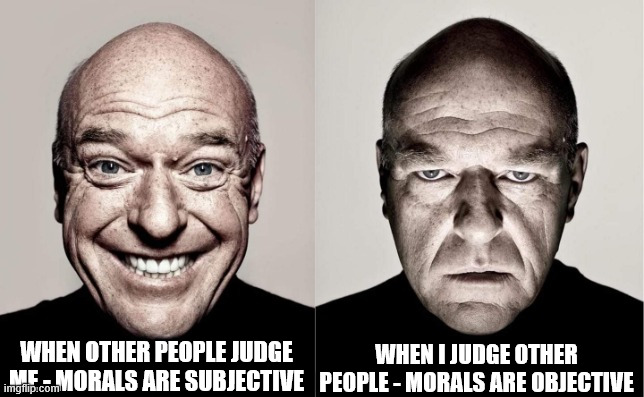
Morals seem to differ from time to time and from society to society. Just like how we built a system to understand the nature of reality, we could also build a system of morals. This means we need some brute laws. When we built the scientific system, we had the external world we perceive, which is objective. This allowed us to add laws to the system, reaching consensus with others using a strictly defined scientific process. Morals are not like that. On what basis can we reach agreement with others on what is morally right and wrong? For that to work, we need everyone in the society to agree on the same thing, which is not an easy feat when you have millions of people in the society.
This is what religion did for societies. Once they got people to agree on God as an entity, they were able to come up with moral rules as propounded by God, which everyone has to follow, like the ten commandments. Some religious thinkers - and some characters in Dostoevsky - warn that without God, shared moral values lose their footing. Other philosophers, including many existentialists, disagree and argue we can (and must) build morals without God.
Can we find a common ground? You might have heard of Maslow’s hierarchy of needs.
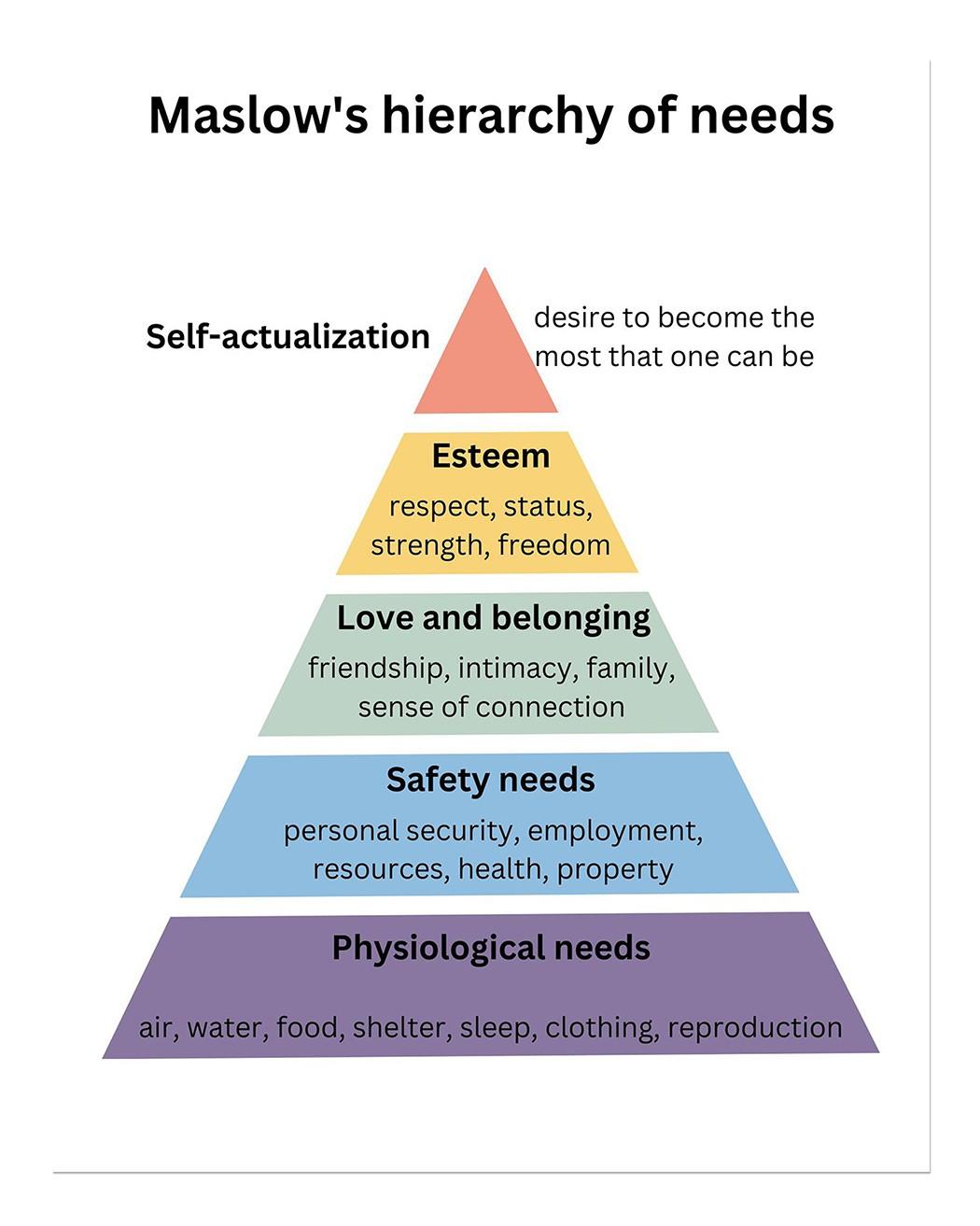
This seems to be a strongly-opinionated prioritised list of what humans need. Many people don’t agree with this entirely as there are always people who outright reject some of them or prioritise them in different orders. I could think of numerous people I know who don’t care about reproduction or status. But anyway, if we do find a common ground in any of these needs, we could build morals from there.
Nuances
The other difficulty is with the nuances of the situation which makes it really hard to come up with a simple set of morals like the ten commandments. The examples we saw in the beginning of the chapter show how the same act may be good or bad, depending on the situation.
Imagine a moral framework with the following statements:
Thou shalt not kill
Thou shall not steal
But you ended up being a vet and you have been asked to euthanise animals which are struggling in pain and cannot be saved. You either refuse to do so or make a claim about reality that animals aren’t as alive as humans and it is okay to kill them. This will go as an update to your philosophical belief system.
Popular moral philosophies
Deontology
Deontology is most famously associated with Immanuel Kant. Roughly, it says: judge the act itself, not the outcome - an act is right only if the rule behind it could fairly apply to everyone, and if it treats people as people rather than tools. Killing is bad, lying is bad, stealing is bad, etc. As we just saw above in that example, even a simple moral “killing is bad” may not stand the test of some real world situations.
Consequentialism
Then there is consequentialism which says that it is the consequence of an action that decides whether an act is good or bad. If telling a lie to someone dying makes the person die happy, it is a good deed according to consequentialism. One might ask how the consequence is evaluated if it made some people happy and some people sad. This is where moral philosophies like utilitarianism come in, which provide us a framework to evaluate the outcome of an act.
Virtue Ethics
There is virtue ethics that focuses more on the virtue and intention of the person doing the act instead of the act itself or its outcome. The problem? The private nature of mind. As it goes with many romcoms and sitcoms, how do you know if a guy is helping out a woman because he has good virtues or because he wants to get laid?
Nietzsche
Many philosophical academics claim that Nietzsche is the most misunderstood philosopher, probably because they don’t understand him either. He is quite controversial. After his death, his sister Elisabeth - a German nationalist and antisemite who later joined the Nazi Party - took control of his unpublished notes and assembled The Will to Power selectively, downplaying his attacks on nationalism and antisemitism. The Nazis later exploited that distorted edition.
Yes, he is hard to understand. Yes, there are lots of edgy teens who pick and choose what he says to sound cool without understanding the context. But he does make a lot of valid points.
His primary argument is that the concepts of good and bad have gone through a few changes across time and different societies. He is particularly critical of the impact of Christianity in global morals. He says that with Christianity, the weak people managed to redefine good and bad in a way that helps themselves. He calls it the slave morality. And this morality has followed us across centuries. He criticises this morality because he thought this ‘slave morality’ held back exceptional individuals from becoming what he called the Übermensch. He never gives a neat replacement rulebook. His famous line is ‘God is dead’ - meaning the old religious foundation for morals has collapsed - and he warns that we now face the hard task of creating new values for ourselves.
As with the philosophy about reality, you are free to pick a moral philosophy.
Further Reading
- Groundwork of the Metaphysics of Morals by Immanuel Kant
- Utilitarianism by John Stuart Mill
- On the Genealogy of Morals by Friedrich Nietzsche
- Beyond Good and Evil by Friedrich Nietzsche
- The Iliad by Homer