15. Words and Meanings
Before we jump into the What Ought To? question, let us discuss some social constructs first. The first construct we will discuss is Language. What is language? We could say that it is a system we use to communicate thoughts with one another. While most would assume that the goal is to communicate between people, it doesn’t have to be the case. A programming language allows us to tell a computer what to do. Digital devices encode information in binary language, which software then decodes and displays as human-readable text, images, or sound.
What does a language contain? It has a set of basic symbols - like the letters of an alphabet - and a shared mapping between combinations of those symbols and things, ideas, or actions in the world. We map an apple, which is a combination of 5 characters from the alphabet that maps onto a real world fruit. A dictionary is a useful record of how most people currently use the mapping - though no dictionary officially decides it; the real ‘authority’ is just shared usage. Are languages precise and perfect to communicate ideas?
Approximation
If you are eating a cheeseburger in your favourite burger shop and you are telling this to your friend in an audio call, do you think your friend who has never been to this shop can recreate the scene perfectly in their own mind, even if you describe the scene for ten minutes? Obviously not. Why is that?
Because, language does plenty of approximation. You may say that it is a small shop. Your friend may think it is smaller than it actually is. You may say that the shop is painted blue. Blue is such a large spectrum in colour and chances are high that your friend thinks a different blue. You may just say cheeseburger though you are having a double cheeseburger. Your friend may imagine a burger with a single patty.
The problem here is that if you want to transmit accurate information, then you will have to send information about every point in space to your friend. Remember the debate we had about infinitely small space? If space can be infinitely divided, you will never be able to transmit all the information to your friend. They will probably disconnect the call and block you forever if you attempt to do so. Even if space isn’t infinitely divisible, depending on how small the smallest discrete units of space are, you still can’t practically transmit all the information even in a million years.
In reality, no one needs this level of detail. If you give some approximate information, people can fill up the gap themselves though it is not accurate. We generally have very limited time to communicate and we want to be efficient at it. It doesn’t matter which type of blue was painted on the walls of the shop, telling that it is blue is enough, assuming that your friend really cares about the colour of the walls of a burger shop.
How about communicating with an image? An image does a much better job at it obviously. But images also have limitations on how many pixels they can hold. For example, the menu displayed may not be clearly visible no matter how much they zoom in. They may do a better job at colours. For colours, we still have the problem of whether the wavelength of light is infinitely divisible. If yes, the image, though it gets much closer, may not be accurate as the digital images don’t have infinite precision. If the actual wavelength is 590.13234243324 nanometers, the image might have to just stick to 590 nanometers.
What about the mathematical language? Is it more accurate than the spoken language? Most would agree that it is. No matter how infinitely divisible space or the wavelength of light may be, mathematical notation can express far more precise values than everyday speech - you can always add more decimal places in principle - though even mathematics has practical limits because you can’t write out infinite number of digits. But whether it is practically possible is a whole different question. As discussed before, we don’t have devices which are perfectly accurate and physics suggests we never will - quantum effects and unavoidable background noise put a fundamental limit on measurement, not just an engineering one.”. And even if we have devices with an accuracy of 100 decimal places, it would be expensive and time consuming to communicate with that level of detail.
This approximation causes what philosophers call vagueness - what I’ll call the Boundary Problem here. Where does yellow end and orange start? If I pick a wavelength right around the border between yellow and orange in the spectrum, there will be people who disagree on whether it is yellow or orange. Some may say that it is orangish yellow. Then it becomes a question of where does yellow end and where orangish-yellow begins.
Subjectivity
How do we build the mapping between words and their meanings? We need to reach consensus. I could point to an object and say, “I would like to name that colour blue.” You might agree or suggest a different colour name. Same for shapes and sizes.
What if I point to a painting and say, “That’s beautiful”? You will ask “What does beautiful even mean?” How am I going to explain what is beautiful? You could explain it in terms of your feelings when you see the painting. But different people get different feelings when looking at the same painting. This brings us back to the objectivity vs subjectivity problem that we discussed before. What we consider objective, we tend to agree on what the word is. But it is hard to agree on anything that is subjective.
In general, you could get away with talking about subjective things in a subjective way.
The painting is beautiful -> I find the painting beautiful.
It is a difficult hike -> That hike was difficult for me.
It is a great movie -> I loved that movie.
Doing this makes you agreeable in many situations. The problem starts when you are discussing things which are in the borderline between objective and subjective - like morals.
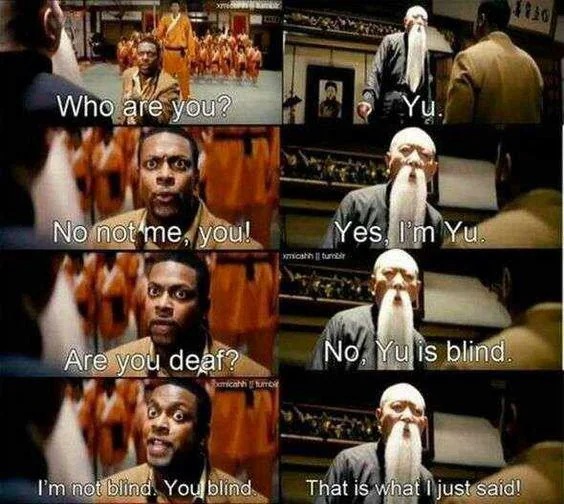
I will end this chapter with this wonderful philosophical conversation from the movie Scary Movie 3 (2003).
CJ: My aunt Shaneequa used to live over there! But that b*tch got evicted though.
Mahalik: For what?
CJ: Mice.
Mahalik: I thought she had rats?
CJ: No, rats are outside, mice are inside.
Mahalik: But what if a mouse goes outside does it become a rat, and if a rat is in the house, is it a mouse?
CJ: I ain’t seen no mouse outside. That’s what I’m sayin’.
Mahalik: That’s because it’s a rat, fool!
CJ: Damn! You mighta just made fact. That’s some real shit right there! A-Ha!
Book recommendations
Philosophical Investigations by Ludwig Wittgenstein