12.1 What is Life?
How do you know if something/someone is alive? Is there even a binary answer to this question? Or do different beings have different levels of life? Depending on the nature of reality aka ontology people believe in, they may have different answers to this question and each answer has some uncomfortable implications.
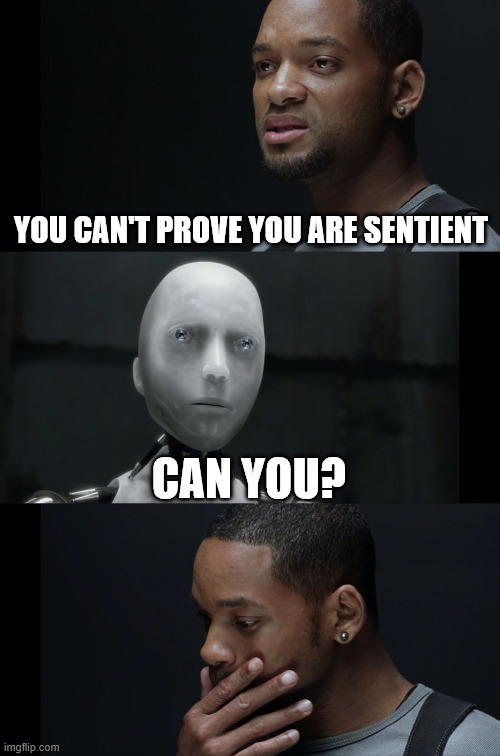
Most of us would agree that a living thing is anything that has a “conscious experience”. If a robot doesn’t “sense” anything, in terms of seeing colors, hearing sound, no matter how good it is in solving real-world problems, we won’t consider it a living thing. All it does is process bits in its hardware. A colour in a camera image it is processing is just a number it stores in the chips. But what if the robot does have a conscious experience like us? What if it does have a mind with a qualia like us? Will we ever know? This is where the problem of private mind, our inability to have direct access to the consciousness of others makes things difficult. If we did, we could use that to decide if something is alive.
Take the Chinese Room argument by John Searle. “Knowing” something is part of our conscious experience. Imagine a person who knows only English sitting in a room. People outside the room insert notes written in Chinese into the room through a window. The person inside has a huge book that tells him what Chinese reply to write and send it out for each of the incoming questions. It would be impossible for the people outside to know if the person inside knows Chinese or not. Searle used this example to show that a computer program can never be “conscious” because that is pretty much what many computer programs do - Looking up answers from a database.
There are many arguments against this. One of them is that a complex AI machine does more than just passively look up data. Another response is that though the person inside does not understand Chinese, the entire room does.
Again, we run into this problem because we don’t have access to the consciousness of other beings or other things, if things do have consciousness as panpsychism posits. As we don’t have that access, we are left second-guessing whether something else is a living thing or not.
Considering these limitations, using conscious experience as a property to decide whether something is alive or not seems impossible. We could use it to define life but it won’t be useful practically to identify if something is alive or not. So, how do we define life and identify if something has life? We use some behavioural traits to determine what counts as life. For example, NASA defines life as a self-sustaining chemical system capable of Darwinian evolution. Biologists and physicists tend to have slightly different definitions depending on metabolism and other processes involved.
Most of the definitions of life are either too strict to the point that even what could potentially be living things are left out or too broad that what many consider non-living are also considered living. For example, with the NASA definition, a hybrid mule isn’t a living thing because it cannot reproduce. If we cloned humans in labs who could never reproduce naturally, they’d fail the test too. To compensate for it, if we remove both reproduction and evolutionary requirements, it creates other problems. We could argue that chemical robots are alive.
Let us look at how different philosophies define Life. Physicalism for example, would define it in terms of complexity of cells, DNA and metabolic processes. DNA is particularly interesting because the accuracy with which DNA is copied across millions of cells is not easily reproducible as a natural process, which makes it a good candidate for defining life.
Physicalists disagree with each other over whether a virus is a living organism. Viruses contain DNA or RNA but they don’t have cells. If you believe that presence of cells in the body is a mandatory trait to consider anything living, then viruses are not alive. If you don’t think that is the case, then viruses are living things as long as they have DNA or RNA. Where you draw the line is up to you.
Where in the evolutionary chain did life really start? Again, different physicalists would draw a line at different points. Or they might say that we do not know now but we will find the answer eventually. We still haven’t understood how life started on earth. The earliest living organisms we know of are bacteria which seem to have appeared on earth about 3.5 billion years ago while there are controversial studies showing that bacteria appeared much earlier. Considering that the earth formed only about 4.5 billion years ago, the appearance of bacteria within a billion years seems pretty quick in the cosmic scales.
We don’t know what really led to the creation of these bacteria. There are many theories ranging from chemical lakes developing life through chemical reactions to aliens dropping life here. But the question of when or how life started remains a mystery.
Going back to the question of whether life is binary or not, Douglas Hofstadter, for example, says that how conscious a living thing is, depends on the complexity of a self referential loop in its brain. He says that with evolution, the brain develops the ability to see more and more of its surroundings. In this process, it eventually learns to recognise itself and develops a sense of self. Some organisms don’t have any sense of self, some have a partial sense of self while humans have a well defined sense of self. This is the result of a self referential loop in the brain.
This loop determines its sense of self and hence life itself. The implication of this approach, which he accepts honestly, is that this creates a hierarchy of life. Humans are more conscious than animals, and different animals have different levels of consciousness. The hierarchy doesn’t stop between different species. There is a hierarchy even among humans. Depending on the state of the brain, some humans would be more conscious than the other humans. Babies are less conscious than adult humans. Does this mean we should treat babies as lesser humans? The counter argument is that babies will eventually become more conscious. So we shouldn’t treat them as lesser humans now. What about adult humans who are less conscious? Are we ready to face the moral implications of this?
For a substance dualist, the answer would be that anything that has corresponding “mental substance” is a living thing. But we don’t know anything about the mental substance. How do we know if something has a mental substance or not? For all we know, some humans may not have that mental substance and are just philosophical zombies. Do animals have similar mental substance? Descartes claimed that animals don’t have any consciousness at all. If he were alive today and on social media, his posts would be controversial.
As discussed earlier, we have panpsychism on the other extreme, which claims that all physical substances have both physical and mental properties. Even the seat you are sitting on, even atoms and molecules, all have consciousness in them. Only the scales vary. Where do we even start building morals for such a philosophy?
Idealism also has issues similar to substance dualism, depending on what kind of idealism we are using. If we are dealing with a Berkeley-style view, one might ask which of the beings we see in the dream are real people who are part of the dream and which ones are just imaginary characters that God has added to the dream?
As you have seen so far, the answer to the What is Life question has a lot of moral implications. Different people draw a line at different points. The moment something falls on the side of the line that says it is alive, you start asking how much importance should be given it its life. Most people draw the line somewhere and do not think about these moral implications. Some do think and end up being choosing veganism, vegetarianism, pescetarianism, etc.
On the other extreme, you have the Jain monks. Jainism is a religion in India that propounds that one must live a life causing the least impact on the other lives. A natural outcome of this view would be following veganism. But many strict adherents of Jainism go a lot further. They even avoid eating root vegetables because it kills off the plants. You think that is shocking? Some monks carry a broom when they are walking to gently clear away insects on the floor to avoid stepping on them.
Overall, this is a philosophical question that doesn’t have a definitive answer. All of us end up writing a brute statement in our system to draw a line on what is considered life and get on with it, irrespective of whether they are consistent with the other statements in our system or not. This problem would get more interesting if aliens show up on earth one day.