10.3 Quantum Physics Interpretations
Life was simple when we just believed in classical physics. Classical physics did have its own problems around the question of free will if determinism was true. But none of them comes close to the kind of problems quantum physics created for both philosophy and science.
To recap what we learned in the chapter about quantum physics, unlike classical physics which allowed us to measure the state of things at one point of time as precise numbers and predict accurately (in theory) the state of things at a different time, quantum physics defined the state of particles in terms of wave functions. The wave functions that describe the state of the particles evolve with time. But they don’t tell us the precise state of the particles. They only tell us the probability of what we will find when we observe the state of the particle. When we make observations, the wave function collapses to give us the state of the particle that follows the probabilistic predictions we make from the wave function. Two big questions arise from this:
- If the wave function “collapses” only when we observe, what was its state before we observed it? What is “real” before we make observations? This is called the Reality Problem.
- What exactly happens when we make observations that causes the wave function to collapse? This is called the Measurement Problem.
Firstly, what does “observation” or “measurement” mean here? If I had a measuring device that measures the position of a particle but I look at the measurement on the device only the next day, which of these two activities count as observation? Is it when the device recorded it, or when I looked at the device reading. Most scientists stick to the former definition. Some philosophers argue that the “observation” only happens when a conscious observer reads the measurement because no one knows the state of the device unless a conscious observer is able to look at it.
When we say that quantum theories only give us the probabilities of finding something somewhere, the first conclusion that we reach is that we just don’t know the correct equations. There is something missing in our equation that makes it probabilistic rather than being exact. Maybe if we find what is missing, we will be able to find an equation that makes accurate predictions. Einstein was a staunch supporter of this idea. He rejected the idea that nature is fundamentally probabilistic. You may have heard of his popular quote - “God does not play dice with the universe.” Einstein meant it metaphorically, not literally - he was rejecting the idea that nature is fundamentally random.
Anyway Bell’s theorem proved mathematically that no local hidden variable theory can reproduce all the predictions of quantum mechanics. I stressed the word local because it is an important caveat in the Bell’s theorem. It adds a condition that nothing breaks the principle of locality, which means that nothing can travel faster than the speed of light. If this is the case, then the hidden variable theory cannot be true. So far we haven’t found anything that breaks the speed of light, and hence we are inclined against believing that a local hidden variable theory is true. (Non-local hidden variable theories, like the pilot-wave theory, aren’t ruled out by Bell’s theorem - but they require instantaneous action across distances, which most physicists find too high a price.)
If the hidden variable theory is not true, then what are our other options? The two widely accepted ones are the Copenhagen interpretation of Quantum mechanics and the Many-worlds interpretation.
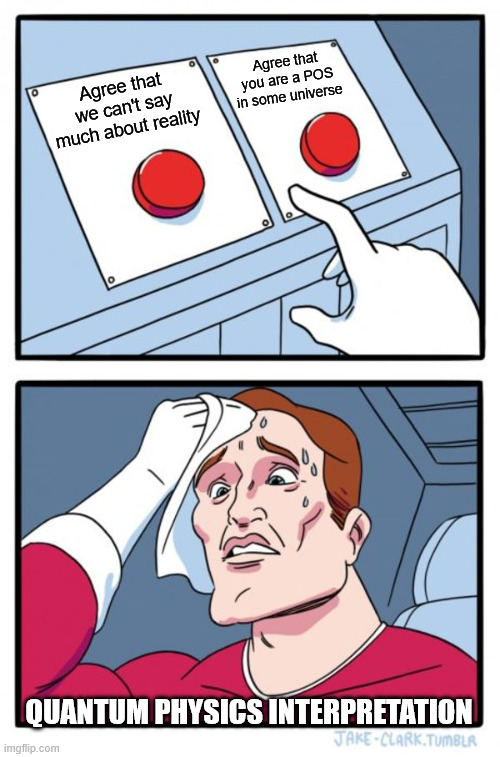
The Copenhagen Interpretation states that there is no point in assigning definite physical properties to a particle before it is observed. It is in a quantum superposition, which is described mathematically. We cannot say how or what it is in reality. It is only when we observe that we can assign meaningful properties. Until we observe it, we can’t explain what state it was in.
This explanation (though it doesn’t really explain and just gives up) wasn’t satisfactory to many physicists who wanted a sense of understanding of reality. The other interpretation that is the Many-Worlds interpretation gave them that. According to this interpretation, at every measurement, the universe splits into multiple universes and depending on the universe, the observed measurements differ. How is probability explained here? Why does one outcome have a higher probability over the other? It is explained by a concept called quantum amplitude. The rough idea: each branch of the universe has a number attached called its amplitude, and the square of that number gives the probability (this is called the Born rule). Why the universe should work that way is still debated - that’s the ‘probability problem’ of many-worlds. It is a fun theory though. The many-worlds theory is a staple in many science fiction and even in superhero movies and books.
With all these interpretations, one can see why this is not just a scientific but also a philosophical problem. If the Copenhagen interpretation were to be believed, then what exactly is reality? How can we believe in Physicalism if even Physics doesn’t say anything about the nature of reality? If the many-worlds theory is to be believed, it gives rise to a lot of moral questions - I may be a good person in this branch. Does that mean there are other branches where I am an evil person who uses loudspeakers in public transport? But physicalism does survive in the many-worlds theory as the numerous universes are still physical entities which are considered the ultimate reality.