10.1 Trust Issues
Let me begin this by introducing to you the lovely gentleman named Descartes’s Demon. Descartes introduced the Demon as a thought experiment to show how our senses could not be trusted.
The demon makes you perceive a world that does not really exist. One could see analogies of that from the Matrix movie where the machines do this to us at scale. The machines in the “real world” are the evil Demons which fill our senses with a fake world that did not really exist. Though a question has to be asked, how did Morpheus, Neo and all the people who took the red pill know that what they thought was the “real” world wasn’t a matrix in itself and they were in a nested loop of an infinite number of “real” worlds? Imagine them celebrating Neo defeating Agent Smith, only for John Travolta to show up with another pair of red and blue pills and saying that their world wasn’t real either.
Anyway, the question is, can our senses be trusted? According to physicalism, light waves, sound waves, etc. reach our body. These get converted to some signals in our nervous system and they eventually reach our brain where some physical process happens which translates it to an experience we are having. The philosophy of physicalism itself allows for so many reasons why what you sense may not be real.
- Remember the planetarium theory? The universe outside of the solar system could just be an illusion created by a spherical planetarium. Though if this is true, the Voyager spacecraft which is leaving the solar system could hit the boundary at some point.
- We could be fitted with a virtual reality device that controls all the signals that are reaching our body.
- Maybe, in a future world, some advanced biotechnicians could hijack our nervous system and send the signals that would make us sense Pikachus everywhere we go.
- Or, some neuroscientist could hijack our brain itself to create an illusion that you are living in a different world, like the Matrix.
- And even if what you are sensing at a moment is real, what about your memories? What if the demon modified the past memories in your brain to make you believe that you owe money to the demon?
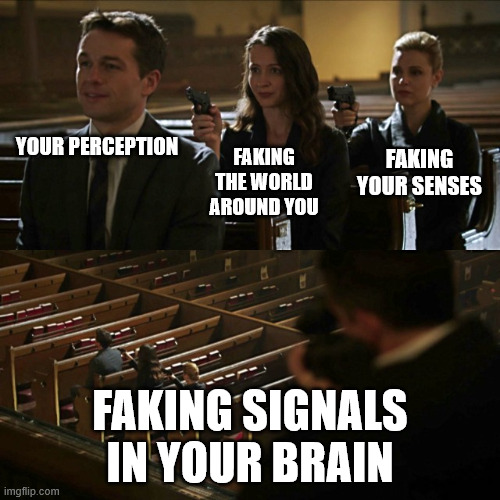
Why is this a big problem? Remember the rule of the scientific system - Any law added to the system must make observable predictions and be falsifiable. Our entire system depends on us making observations which are real. And yet, according to the physicalist philosophy, our own senses cannot be trusted. If our own senses cannot be trusted according to physicalism, how can we make observations to verify the scientific theories? Put it another way, our description of the nature of reality (Ontology) makes our primary source of knowledge (primary epistemology) not so trustworthy.
Maybe we can rely on the information we receive from the others to confirm our observations. Remember that even those “others” could be faked in this illusion. Add to the fact that our own memories let us down sometimes, the foundations get a bit shaky.
I admit that this is just a theoretical attack on the foundation. I don’t expect nor advise anyone to take this seriously unless they want a free ticket to an institution. But it is still a fun thought experiment and a valid attack on the foundations of physicalism.