3. Knower, Knowing and The Known
To tackle the What Is? question about the nature of reality, we need to find the components of our experience which we should explain. To keep things simple, we need to find the bare minimum components which cover everything we experience. Simple, isn’t it? How do we go about that?
Let us start with a clean slate, Tabula Rasa, a Latin term which was popularised by John Locke. John Locke used it as a metaphor to a newly born human’s mind. His point was that humans are born without any kind of in-built knowledge and learn as we observe the world, unlike the rationalists (Descartes, Leibniz), who argued that some knowledge is innate.
I am not going to dive deep into that debate. I used Tabula Rasa as a metaphor for how we should start thinking about the problem - try your best to forget everything you have learned over your life and start thinking with a clean slate. This is similar to the path which René Descartes took with his meditations. He wanted to find one thing whose existence he could be absolutely sure of. He came up with “I think, therefore I am.” His argument was that as he is the one who was thinking, his existence is of absolute certainty. Now the meaning of this “I” is itself an interesting philosophical debate. But let us leave that aside for now. He started from there and then tried to find more “truths” following that statement.
Similarly, I want you, the reader, to empty your mind of all the assumptions you have made in your life and start with only the absolute truths you are sure about. Though our starting point is similar to Descartes’s, the goal is different. Descartes wanted to build an entire philosophical framework. Our goal is just to find the components of our experience we will have to explain in order to answer the What Is? question. I have written my thought process in a first person perspective. Hope you can read it from your perspective. Here it goes:
I think, therefore I am.
I am having an experience of being inside a body. I perceive a world outside my body through my sensations. I can see, I can smell, I can hear, I can taste, I can feel a touch, I can feel hot/cold. These sensations give rise to internal feelings like joy, sorrow, anger, love, hatred, embarrassment and many more.
I can think. Thinking is what I am doing right now. I could imagine things, I could recognise patterns. I could ask questions. I could do logical reasoning.
I have will. I could decide to do something and act on it with the body that seems to be in my control.
If you are still with me and you are still wondering what that rambling was all about, I was trying to find the components of our experience which cover all of our experience. To summarise,
- We perceive a world through sensations (vision, hearing, touch, taste, smell). We have second-order internal sensations named feelings (anger, joy, sorrow, excitement, etc.)
- We have the ability to think.
- We have the will to do something and act.
Any solution we come up with, for the What Is? question, must explain how we perceive the external world and the internal world, how we think and how we experience the will to do things.
Academic philosophy splits the whole What Is? question into two topics:
- Ontology - The study of nature of reality. Both the knower and the known, the subject and the object, and their nature are studied as part of this.
- Epistemology - The nature of knowledge. How do we learn about reality? What kind of knowledge is valid?
To explain with examples, Ontology would say that the universe sits on top of a turtle or the universe is nothing but a simulation inside a Matrix. Epistemology might say that only the knowledge we gain from scientific experiments is true knowledge but if your neighbour tells something, you can’t trust it to be true. Note that the subject and the object are both part of Ontology. Only the act of knowing is part of Epistemology.
At this point, I have to point out the circular nature of epistemology/ontology. As I said above, Ontology is the study of the nature of reality. How would you know the nature of reality? Through Knowledge. Epistemology is the study of the nature of knowledge. How do you know if a particular type of knowledge is true? Based on the nature of reality. If you are hooked on a Virtual Reality headset, what you know about the nature of reality (that you are living in a world in which you are hooked up to a VR headset) tells you that what you perceive in the VR headset isn’t the truth and is not a valid form of knowledge.
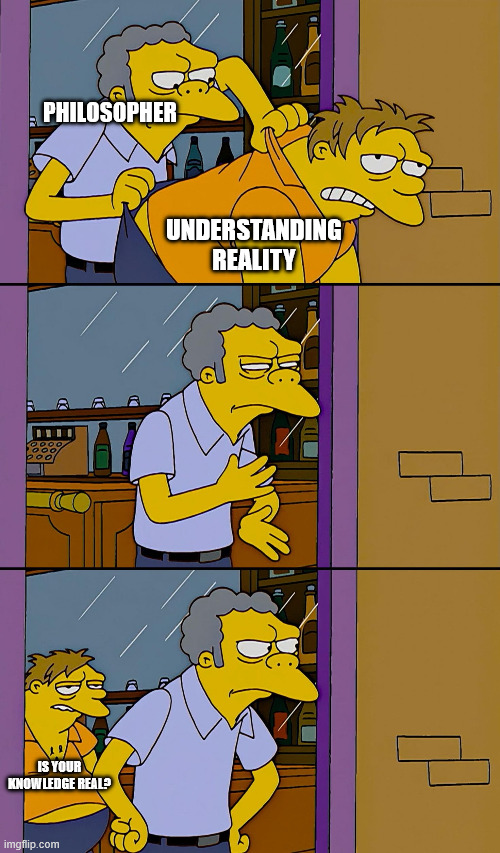
So, you need to know the reality to validate the knowledge. And you need to know the validity of your knowledge to make statements about reality. How do you know for sure that you are indeed from a different world and what you are experiencing is just a virtual reality? This is a classic circular dependency. Great place to start philosophy, isn’t it? In practice, most philosophies dealing with the What Is? questions come in pairs of Ontology and Epistemology. The challenge is to make sure that the relationship between the nature of reality and how you gain knowledge in this reality is consistent and don’t contradict one another.
For example, let’s assume that I propose the following Ontology - Our universe ends at the solar system. There is a spherical boundary after that, which is designed like a planetarium, which gives us the illusion of a huge universe with more stars and galaxies outside. If we try to travel far out of the solar system, we will either hit the boundary or we will end up on the other side of the solar system. We will never be able to leave it. There are some egg-headed aliens observing us like this is a zoo. They can see us but we cannot see them.
What about epistemology? I say that all you see is true and observing things around you is a valid form of knowledge. Nothing else.
Now, this creates a problem. A philosopher may ask, “If we cannot see outside of the planetarium, how did you know the existence of the egg heads? Did they visit you and give you a probe or something?”
This philosopher has pointed out the inconsistency between my ontology and epistemology. According to the nature of reality, there is no way for anyone to know the existence of anything outside of the planetarium. But I claim to have received the knowledge and I am rightfully questioned by the philosopher.
So, any combination of Ontology/Epistemology should tell us a story that is consistent with each other. Not only that, they must also be consistent with the world we are observing on a day-to-day basis. It must explain how we have the sensory experience of a world, how we think and how we feel a sense of will. Many people can imagine worlds/universes which are just consistent with each other. Fantasy fiction is full of that. But to also make it consistent with our own experience is where the challenge lies.
Ontology specifically must explain both the knower (our mind/self) and the known (the world). Epistemology explains how our self/mind can know the world. The self/mind is the subject that is the knower. The world is the object that is known.
Before we finish, I will also quickly point out another circular reference. I said that part of our experience is thinking and it should also be explained by the ontology/epistemology pair. How are we trying to answer the question? By thinking.
Before we dive deeper, I would like to ask you to keep an open mind. Start with a clean slate as I mentioned in the start of this chapter and get rid of all the assumptions we have made in our lives so far. Many philosophies may sound outright stupid but you may not be able to prove them wrong. That is what makes it fun.
Book recommendations
Does the Center Hold? By Donald Palmer
Meditations on First Philosophy, by René Descartes.